

What’s Involved in Stabilizer or Reamer Repairs?
What’s Involved in Stabilizer or Reamer Repairs?
DB Bit Services
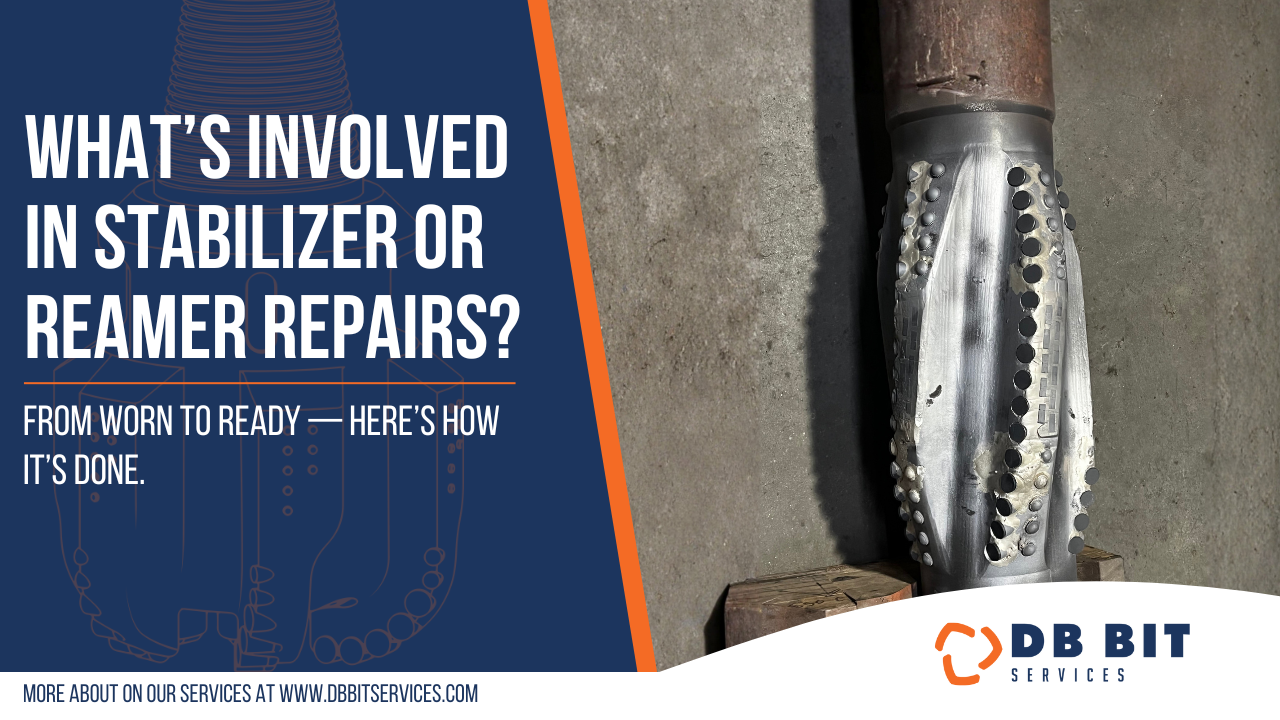
Stabilizers and reamers are critical tools for directional control, hole conditioning, and torque management during drilling operations. But like any downhole tool, they face wear from abrasive formations, high loads, and extended runs.
At DB Bit Services, we don’t just repair drill bits—we also handle stabilizers and reamers with the same level of precision and turnaround that our customers count on. If you’ve never had one of these tools rebuilt, here’s what the process typically involves.
Why Stabilizers and Reamers Need Repair
Over time, stabilizers and reamers experience:
- Blade wear from formation contact
- Hardfacing erosion in high-ROP zones
- Gauge loss due to toolface degradation
- Surface cracking or washout from fluid dynamics
- Cutter degradation (in the case of rolling or replaceable cutter arms)
Worn stabilizers or out-of-gauge reamers can lead to wellbore quality issues, toolface instability, poor directional control, or even premature bit failure. Repairs are a cost-effective way to return these tools to service without purchasing new.
Our Repair Process at DB Bit Services
1. Tool Inspection & Wear Assessment
We begin by measuring wear patterns, checking gauge dimensions, and evaluating blade condition. For adjustable or rolling cutter reamers, each moving part is inspected for damage or fatigue.
2. Material Removal & Cleaning
Old hardfacing, build-up, or failed welds are removed. The tool is cleaned thoroughly to prep for welding and buildup.
3. Rebuilding Blade Structure
Worn blades are rebuilt using compatible welding techniques and filler materials. In some cases, we replace worn arms or sections as needed.
4. Hardfacing Application
Once rebuilt, the tool receives fresh hardfacing material—selected for your application and formation type. Our techs apply wear-resistant overlays using stringer or cross-hatch patterns depending on operator specs.
5. Gauge Reset & Machining
Precision machining ensures the stabilizer or reamer is brought back to correct gauge. We verify symmetry, blade height, and diameter tolerance before final quality checks.
Common Types of Stabilizer and Reamer Repairs We Perform
- Integral blade stabilizer rehardfacing
- Sleeve-type stabilizer rebuilds
- Reamer blade arm replacement
- Cutter assembly rebuild or rotation
- Gauge pad restoration
- Thread repair and recertification
Whether you're working with a 6¾” tool or something much larger, we have the experience and equipment to handle it.
Repair Over Replacement: Smarter Asset Management
Repaired stabilizers and reamers offer the same directional performance and longevity as new tools—without the lead time or cost. If you’re managing inventory for an active drilling program, repairs allow you to maintain uptime and control expenses.
At DB Bit Services, our turnaround is fast, our pricing is transparent, and our workmanship is trusted across multiple basins.
Need a quote or want to send a tool in for evaluation? Contact us today.
www.dbbitservices.com